Gilbert witnesses Helen with Frederick Lawrence and breaks with her
The Tenant of Wildfell HallGilbert witnesses Helen with Frederick Lawrence and breaks with her after interpreting a private garden conversation as proof of an intimacy between them. The episode makes his jealousy a cause of estrangement rather than a reliable guide to Helen’s life: he rejects her explanation before hearing it, and only afterward receives the manuscript that will disclose the history behind her reserve. Because Gilbert recounts the mistake retrospectively in his letter to Halford, the scene also marks a hinge between his limited first-person impressions and Helen’s account of her marriage.
The Garden Scene and Gilbert’s Inference
Before he sees anyone, Gilbert is already troubled by the possibility that others believe the scandalous things said about Helen. He stands at the garden wall, looking toward the light in her parlour and wishing he could speak to her or catch sight of her before leaving. The scene begins, then, not with evidence of betrayal but with his anxious desire for contact, sharpened by the rumors he fears may be true.
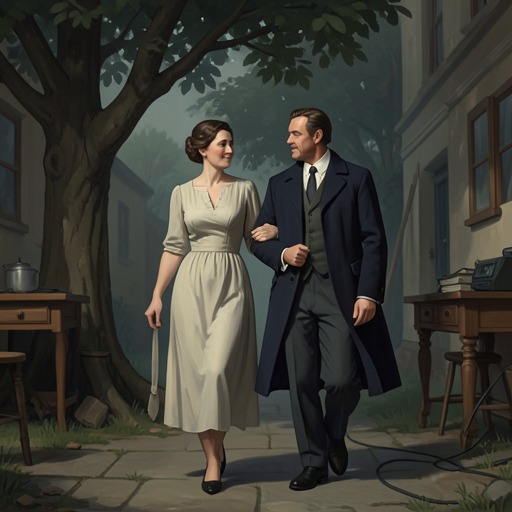
Hidden in the shadow of a holly bush, Gilbert sees Helen emerge with a young man. He identifies him as Frederick Lawrence, not Rachel, and his anxiety intensifies. As the pair pass down the walk, Gilbert hears only fragments of their conversation. Lawrence speaks of not consenting to lose Helen and says he must go with her or come to her; Gilbert then sees him put an arm around her waist while she rests a hand on his shoulder. The gestures and words appear to confirm a romantic bond, but Gilbert has witnessed only part of a conversation and does not know its context.
His response is physical and immediate. Darkness seems to cloud his sight; his heart sickens and his head burns. He rushes from the wall, tumbles over it, and throws himself on the ground in anger and despair. The intensity of his reaction gives the mistaken conclusion the force of certainty: in the moment, he experiences the scene as a devastating discovery, although its meaning remains unverified.
Refusal and Estrangement
When Helen later approaches him, she sends the child away and addresses Gilbert directly. He answers calmly and coldly, aware that she is miserable but glad to possess the power to torment her. Helen says that she can bear being suspected and condemned by everyone else, but not by him, and asks why he failed to come on the day she had appointed to explain herself. Gilbert replies that he has already learned all she would have told him, and perhaps more. His confidence rests on the garden scene, not on knowledge of the facts.
Helen insists that she would have told him everything, but then withdraws that offer, judging him unworthy of her confidence. She says he has misunderstood her and listened too readily to her traducers; the trust she had placed in him, she now says, was misplaced. Gilbert leaves because he believes his departure will hurt her. Looking back, he sees her turn as though hoping he might still be beside her, then move rapidly across the field with little Arthur. Her bitter distress is visible to him, yet he chooses to affect indifference rather than reopen the conversation.
The break is therefore not a mutual declaration that they should part. It arises from Gilbert’s decision to treat suspicion as settled fact and his deliberate use of distance to punish Helen. The episode exposes the difference between his attachment to her and the trust that attachment requires: wanting her intensely does not make him patient enough to hear what she knows.
The Manuscript Changes What He Knows
Gilbert later asks Helen for anything that could restore his former opinion of her and ease his regret. Helen does not answer with an explanation in conversation. Instead, she rushes to her desk, tears a few leaves from the end of a thick album or manuscript volume, and gives him the remainder to read at home. Before he leaves, she calls him back to require its return and insists that he tell no living person what it contains. The physical document is both an act of trust and a carefully bounded disclosure: she chooses what to withhold as well as what to share.
Gilbert describes the manuscript to Halford as the first instalment of a debt, offering to send the rest later if his friend wants it. He then records that he has the pages before him and begins to recount their contents rather than abbreviate them. The framing matters: Helen’s history reaches the reader through Gilbert’s retrospective letter, but it enters only after his misreading has caused a rupture. The manuscript supplies what the garden scene could not—the context that turns apparent evidence into an incomplete glimpse.
The torn ending preserves a further limit on his knowledge. When Gilbert reaches a passage describing the fine gentleman and beau of the parish, the manuscript breaks off just as Helen is about to mention someone. He assumes that she was about to refer to him, though he recognizes that the reference would probably not be favorable. Even while reading her account, he continues to interpret its gaps through his own place in her story.
Consequences and Narrative Significance
The episode makes the novel’s shift between narrators consequential rather than merely formal. Gilbert’s outer account first gives the reader his jealous perception; Helen’s manuscript then opens a history that his perception could not encompass. Since he shares that text with Halford as a selected installment and reports his own reading of it, the reader’s access remains mediated, but the disclosure corrects the principal error that drove the estrangement.
Gilbert’s later reading also belongs to a relationship that survives the confrontation. Helen’s willingness to entrust him with the manuscript does not erase his failure to listen, but it gives him a way to reconsider the judgment he had made. The scene’s central reversal is thus between looking and knowing: a few gestures seen across a garden wall seem conclusive to Gilbert, while the written account he receives afterward reveals how little he understood when he mistook those gestures for the whole story.